Thursday, October 7, 2010

Baby’s Growth Spurts: Why They Happen and How to Handle Them

Babies seem to grow overnight. Find out why and how to handle your baby clothes shopping.
By Rowena Espiritu

Growth spurts or sudden changes in height and weight of babies and growing kids can be, to some extent, overwhelming for parents. It’s important, especially for first-time moms, to clearly understand different growth changes not only for the purpose of baby-stuff shopping but also to properly monitor ift heir children’s growing and development are on track


Real Moms and Their Growing Babies
“When I was six months pregnant, I got so excited when I learned I was having a baby girl; I bought varied sets of clothes, cute dresses, and shoes,” shares Clyde Reyes, mom to Althea Casey. But just like with many other first-time moms, Clyde’s excitement turned into somewhat of a frustration. “Almost all the dresses I bought for Althea were only used when she was 6 or 8 months old. Then after a month, she was already too big to fit into them,” she laments. She adds that the baby shoes and slippers she bought were used for only one to two months.

Clyde muses, “As a new mom, I was glad that my baby was growing fast at that time—gaining a kilo or more every check-up with her pediatrician. But had I known about these drastic growth changes and their effects, I would have been a smarter shopper for Althea’s clothes and shoes.”

Babies Grow Overnight: Fact Or Exaggeration?
Babies naturally go through many stages of development. In the early-year stages, they have growth spurts or sudden growth changes. According to Michelle Claudio-Bautista, M.D., a
pediatrician at the Friendly Care Clinic and Doc’s At Work, growth spurts for babies and young children are very irregular and don’t have a clear-cut pattern.

Dr. Claudio enumerates several reasons for babies’ growth spurts:
• Genetics
• The food baby eats
• Baby’s environment
 

Possible Signs of Babies' Growth Spurts

Although babies have different growth patterns, Dr. Claudio-Bautista suggests that parents, together with their pediatrician, should monitor some noticeable signs that may indicate babies’ growth spurts.

Some pediatric studies show that locomotion activities such as walking, running, or even standing may strain—and as a consequence inhibit the growth of—muscles responsible for these activities. “But since children have less physical activities during their first year, growth is not inhibited,” she explains, “the fastest and biggest growth spurts are experienced when a child is age 0 to 12 months.” She also says that there are numerous growth plates or soft areas near the edges of the bones that fully fuse or calcify only after a few months. Hence, the noticeable transformation from fragile newborn to hardy baby.

“Parents often ask in jest if babies grow overnight. Probably not overnight, but growth development is really faster and easier during infancy,” Dr. Claudio-Bautista stresses. Aside from having minimal locomotion activities, infants also go through numerous and vital nurturing: breastfeeding, intake of all sorts of vitamins, immunizations, plus regular check-ups with the pediatrician. All these also boost babies’ growth.


Pre-Shopping Ideas
Growth spurts are rapid and unpredictable during the infant and toddler years. “We cannot pinpoint the exact months of growth changes,” Dr. Claudio-Bautista says. “Development, whether physical or mental, is very different from one baby to another.” So when shopping for baby and toddler stuff, stick to essentials first. It would be a waste if that pricey designer baby frock spent all but five minutes on your child because she found it too itchy, not to mention or was fully outgrown after just a few months.


Sources:
• Michelle Elaine Claudio-Bautista, M.D., D.P.P.S., pediatrician in Doc’s At Work (Mandaluyong) and Friendly Care Clinic (Cubao and Shaw Blvd.)
• Growth and Development by Edward M. Santos, M.D.
• Websites: scribd.com, health.dailynewscentral.com, emory.edu, theparentreport.com, pediatrics.about.com

by http://www.smartparenting.com.ph/baby/development-child-care/baby-s-growth-spurts-why-they-happen-and-how-to-handle-them/page/2
 

How much breast milk should I store before I go back to work?

23 Jun 2010
Mom, contributor and certified lactation counselor Abbie Yabot shares how a breastfeeding mom can prepare to go back to work and store enough breast milk for baby.
By Abigail L. Vernida-Yabot

Q: I'm planning to go back to work two months after I give birth? How much breast milk should I store? And how soon should I start storing breast milk?


A: Breast milk should be the only nutrition of a child up to six months old. And even if mom will return to work, this is still possible. It's all about preparation.

Generally, it is recommended to directly feed the baby for the first six weeks of life as this is the time the body needs to master the timing and amount of breast milk a baby needs. On about the seventh week, mom can start expressing her milk, using her hand or a breast pump so that she can store milk for her baby. Mommy should start pumping every two hours in between feedings and not mind the amount of milk she produces. Whenever it reaches two ounces, she can then put it in a storage container and freeze it for future use.

Books say that moms should have two weeks’ worth of supply for babies when they get back to work. That should be about 80 ounces or 40 containers of 2-ounce breast milk. Realistically though, because of all the pressure and strain a new mom has, five to seven days’ worth of supply is ideal enough (40-56 ounces). Some moms are successful even below this amount. However, baby may undergo growth spurts which will lead to baby tending to nurse more often. Hence, it is really better to have at least five days’ worth of stock just in case a baby has an increased demand for milk (due to growth spurt) for about two to four days.


If my milk dries out, what can I substitute to feed my baby?

Find out what our expert has to say.
By Gidget Ortiz, M.D.

Q: My baby had been purely breast-fed from birth until her seventh month when we introduced her to the bottle (since I had to work). She resented it.

I tried different nipple brands and different kinds of milk, but still, she wouldn’t feed from the bottle. So we just give her solid food, fresh juice, and water during the day. When I arrive from work at 5 p.m., that’s the only time she gets milk again from me. Is my baby getting enough nutrition this way?

If my milk dries out, what can I feed her so she can get the right amount of nutrition?

—Floresa May Verdejo


A: Yes, the baby is getting enough nutrition from this strategy provided that she is taking an adequate amount of solid foods. You see, you have breast-fed your baby for seven months and this is considered adequate (exclusive breast-feeding is recommended for four to six months). Nutritional requirements are fully met at this age by breast milk alone. At six months, it is good to start the baby on solid foods, which you have done. If she takes breast milk after your work hours, this is just fine.

If she really does not like any other milk except yours, express your milk at other times and store it in sterilized containers.

It usually keeps for 24 hours inside the ref or three months inside the freezer. Just thaw it before you give it to her, and make sure you don’t re-freeze and re-thaw.

At one year old, she can have ordinary cow’s milk with her solids.
Baby can have the following food at these ages:

7-10 months: strained or mashed fruits and vegetables, egg yolk, finely cut and chopped meat or poultry

9-12 months: casseroles, macaroni and cheese, spaghetti, yogurt, cheese, beans

12-18 months: (end of transition from all breast milk or formula to regular food with breast milk or formula or regular milk):
whole milk—16 to 24 ounces
fruits and vegetables—four to eight tablespoons
breads and cereals—four servings (one serving equals 1/4 slice of bread or two tablespoons of rice or pasta)
meat, poultry, fish, eggs—two servings (one serving equals one tablespoon)


SOURCE:
American Academy of Pediatrics Guide to Your Child’s Nutrition


About the Author: Gidget Ortiz, M.D. is a registered nutritionist and teaches nutrition at UP College of Home Economics

Is it okay to breastfeed my baby while I’m sick?

Mom, contributor and certified lactation counselor Abbie Yabot sheds light on whether a mom should continue breastfeeding through an illness or not.
By Abigail Vernida-Yabot

Q: I recently had cough, colds and fever. Is it okay to still breastfeed my baby? She is 6 months old and is exclusively breastfed.

A: Breast milk contains antibodies that increase the immunity of infants and protect them from getting sick. If a mom stops breastfeeding when she is sick, she increases the chances of her child getting her virus too as she stops giving the antibodies to her baby.


Apart from this, a mother’s milk supply may get affected if she stops nursing as she may have a harder time expressing milk (where she has to prepare so much materials) versus nursing (just lying down and offering her breasts to her baby). It’s important for a mom to stay healthy and get her much needed rest due to the demands of having a child. So, if mom is sick or was sick, she should definitely continue nursing to provide her baby with the antibodies to protect him from that sickness. If the mom needs medicine, she can ask her doctor for breastfeeding safe medicines. Check the internet or call a lactation specialist if in doubt. However, other baby responsibilities should be turned over to another caregiver to allow the mom to rest more and recuperate.


by http://www.smartparenting.com.ph/mom-dad/breastfeeding/breastfeeding-basics/Is-it-okay-to-breastfeed-my-baby-while-I-m-sick-

Wednesday, October 6, 2010

Do I still need to give my baby vitamins even if I’m exclusively breastfeeding?

Breastfeeding is best for your child’s nutrition. However, does that mean that you shouldn’t give your baby vitamins? Get the answer from our expert.


Q: Do I still need to give my baby vitamins even if I'm exclusively breastfeeding?


A: Breastfeeding is the only nutritionally complete source of nutrition for baby's first six months. Hence, even without vitamins, breastfeeding assures the completeness of all the nutrients, vitamins and minerals that they will need. In fact, to be very strict about it, when we say exclusive breastfeeding for six months, we really mean NO water, NO formula and NO vitamins. However, for those who give their babies vitamins before their sixth month, there are no contraindications too.

by http://www.smartparenting.com.ph/mom-dad/breastfeeding/breastfeeding-basics/Do-I-still-need-to-give-my-baby-vitamins-even-if-I-m-exclusively-breastfeeding-
Photo from sxc.hu

The Joy of Breastfeeding

Television host, TV producer, former magazine editor and restorer of antique jewelry Daphne Osena-Paez shares the joys and challenges of breastfeeding.


I’ve spent the past eight years, either being pregnant, having babies or breastfeeding. I now have three daughters – Sophia is 7, Lily is 4 and Stella just turned 1—all were breastfed for at least 12 months. I’m still breastfeeding the youngest. That’s a long time to be giving up one’s body for the sake of her children. But it hasn’t felt that way at all. These eight years have been the most beautiful and powerful time of my life.

“I exclusively breastfed all three girls for the first 6 months despite the demanding work schedule.”
It’s not like all I did was drown in domestic bliss either. I continued to work throughout pregnancy, motherhood and nursing. These years have been the most productive for me – independently producing and hosting a TV show, discovering a new talent for designing jewelry and building a brand of home products. Unlike most working mothers, I did not have maternity leaves. With Sophia, I was back at work after 4 weeks. With Lily, I shot a TV commercial on the 10th day after giving birth. With Stella, I had 5 weeks before shooting a commercial and going back to work. I exclusively breastfed all three girls for the first 6 months despite the demanding work schedule.

“I was just doing what for me was the most normal and natural.”
Whenever I share this glory, I get “oohs” and “aahs” like I deserve a medal for being a breastfeeding mom. I don’t know why it impresses people. I was just doing what, for me, was the most normal and natural. It all went hand in hand – pregnancy, motherhood, breastfeeding. It was just a matter of being organized. I wish my situation is more the rule rather than the exception. But in this country only 34% of mothers exclusively breastfeed their children in the first 6 months.

“Breastfeeding is a choice and a commitment.”
People always ask me how I did it – work and breastfeed. I wish I could say it’s as easy as bringing a breast pump and expressing milk every 3-4 hours. I mean it is, but it also takes more than that. Breastfeeding is a choice and a commitment. Yes I brought a manual breast pump with me everywhere I went. I also carried an insulated cooler-type lunch box to keep the milk refrigerated while in transit. I pumped in the car, in mall fitting rooms and in the makeup room. I had established a system of refrigeration and freezing. I did all that, but not all by myself.

As much as I’d like to take credit for successfully breastfeeding all three kids, I couldn’t have done it without the help of people around me.”
The success of my breastfeeding relied heavily on the support of my husband, the entire household, my doctors, my work colleagues and friends. Everyone I knew I was a breastfeeding mama. I made it known to them – so that they could help me. My friends knew I had to pump every now and then. We stayed away from smoky and polluted places. The shop girls at the mall knew I had to borrow their dressing rooms when I had to pump. My house staff knew how to store and thaw the milk. My husband was supportive and proud, and he massaged my back whenever I needed relief. More importantly, he took on the job of burping the babies after a long feed. That was his bonding time with the baby. Even my older kids participated. They were in charge of making sure the pillow on my back stayed in place. The people at work during shoots, knew I had to take occasional breaks in order to express. They sometimes stood as my human fitting room, holding up my shawl to help cover me up. As much as I’d like to take credit for successfully breastfeeding all three kids, I couldn’t have done it without the help of people around me.

I don’t even remember why I wanted to breastfeed. I don’t think I gave myself a choice. Like I said, it was just natural. I never once considered giving my newborns infant formula. During my first pregnancy, I developed a blood clot in my uterus on the 3rd month and this threatened the survival of my baby. I was on complete bed-rest for almost two months. I had a lot of time to read and research on breastfeeding. We also took birthing classes. Before giving birth I told my OB-Gyn and pediatrician that I plan to breastfeed. I had normal deliveries for all three. And all three babies were put on my chest the moment they were born. All latched on within minutes. None of them have developed any allergies or asthma. They never got diarrhea or caught infections when they were babies.


“Breastfeeding was the most convenient thing – no bottles, no snacks, no powdered milk, only the comfort of being on my breast.”
I will tell you that breastfeeding is the most natural and normal part of motherhood. But it is also a learned skill. It isn’t the easiest at first, and it can be painful in the start, but once you establish a rhythm, it is the most convenient and beautiful process. All three kids have traveled on long-haul flights with us when they were infants and toddlers. Breastfeeding was the most convenient thing – no bottles, no snacks, no powdered milk, only the comfort of being on my breast.


I nursed my babies everywhere – in malls, restaurants, airports, cars, parks. I do not own a fancy cover-up bib. I simply used a shawl in places where I felt I required discretion. People are still not comfortable seeing mothers nurse in public. But it was comforting to get smiles and approving nods from other mothers (and fathers) who were going through the same thing as I was. It was like we had a secret code of approval and support. I wish to have a better culture of breastfeeding in this country.

I am far from being an expert on breastfeeding. I’ve read up on it, had a few sessions from experts, and the rest I’ve learned from just doing it. But all babies are different. With my second child I encountered some difficulty because I was doing things wrong. I fell into a trap. I thought an electric pump would increase my milk production, but instead I ended up with an infection. After three weeks of medication, I went back to breastfeeding again, got rid of my electric pump and stuck to my manual pump for when I was working. By the time I had my third baby, I learned how to hand express during the first month when everything was sensitive.

In a few months or maybe even weeks, my youngest daughter will start to wean herself. I can see the signs. She’s distracted. She’s got 8 teeth. She’s walking on her won. I’ve fed all three babies on demand. And I can tell that that with her newly-found independence, she is demanding less milk from me. I take cues from my kids and let the weaning process happen naturally. No pills, no medication. We go through it together.

It has been eight years of being a dedicated and hands-on mother. But this, obviously, is not the end. Mothering never ends. I know I can’t breastfeed them forever. With each weaning I felt extremely emotional. I had enjoyed every moment of being their source of nutrition and love. It may have been the first language of love between my kids and me, but, of course, there are many. Now we are all armed with a strong sense of security and an even stronger bond. And I know, in my heart, that I gave them the best start in life.


Daphne Osena-Paez is a television host, TV producer, former magazine editor and restorer of antique jewelry. She was tapped to join UNICEF as a Special Advocate for Children early this 2010.

Photos by Real Kids Photography
 by http://www.smartparenting.com.ph/mom-dad/breastfeeding/sharing-milk-stories/the-joy-of-breastfeeding/page/3

10 Tips for Breastfeeding Success

Try these 10 tips from the World Health Organization and the Department of Health to help you learn, adjust to, and properly plan successful breastfeeding.

While newborn babies nurse instinctively, it often takes new moms a little longer to get the hang of breastfeeding. Most lactation experts agree that attitude, planning, and technique are crucial to successful breastfeeding.

Get informed. Breastfeeding is best for you and your baby. Allow yourself to be aware of the benefits to provide you the “I can do it” attitude to start and continue breastfeeding. Ask a supportive health professional who can guide you through the how tos of breastfeeding and discuss other related concerns.

Advise your caregiver. Inform your doctor and the nursery staff that you want to breastfeed so that you and your baby will have skin to skin contact immediately after delivery or within the first hour. Make arrangements for regular visits to the nursery for breastfeeding or request that the baby rooms in with you.
Enlist your partner’s support. A child’s nutrition is a shared responsibility. Getting your husband, and even your family, to be supportive of breastfeeding allows you to be motivated to do it. There are breastfeeding meetings that couples can attend that offer practical ideas on how the fathers can contribute in nursing.

Know your breasts. Regardless of shape and size, almost all women can breastfeed. If your nipples are inverted or you had previous breast surgery, go to a doctor for consultation to allow you to discuss ways to still make breastfeeding possible.

Nurse within the first hour after birth. Breast feed your baby soon after birth when your baby is wide awake and sucking instinct is very strong. The American Academy of Pediatrics states that babies who are nursed within the first hour of birth are more likely to become successful breastfeeders.


Nurse often. Frequent nursing in the early days helps you and your baby to get comfortable with breastfeeding and allows you to establish your milk supply. Learn to interpret your child’s hunger cues like being alert, putting hand near mouth, and whimpering.

Express milk regularly. Most mothers find that they are able to produce plenty of milk and their breasts easily get engorged. Express milk manually or with a pump to relieve your breasts from fullness and to keep up your milk supply. You may use the expressed milk for your baby’s next feeding or store it for future use. Breastmilk is good for 24 hours in room temperature, up to 1 week in the refrigerator, 2 weeks in your freezer, and can be stored for 6 months to 1 year in a deep freezer.

Hold off the pacifier. Introducing a pacifier can cause nipple confusion. Hold off its use until your breastfeeding routine is going well and your milk supply is well established, which is usually three to four weeks after delivery.

Encourage your baby to latch on. Stroke your baby’s cheek or lower lip to stimulate latching. To determine if the baby is latched on correctly, make sure your areola and nipple are both in the baby’s mouth and positioned above his tongue. The baby’s lower lips shouldn’t be drawn into his mouth and his chin is touching your breast.

Do not be discouraged when your baby has difficulty latching on. It does take practice for both mother and child.

Get comfortable. When breastfeeding, find a quiet spot to nurse. Sit in a comfortable chair or listen to soothing music. Studies show, and as most nursing moms share, that a calm mind, body, and surrounding allows for a more pleasant breastfeeding experience.

There are a lot of books and manuals on how to make breastfeeding a successful experience. Some new moms usually seek the help of family or friends who have breastfed. There are also breastfeeding support groups who meet regularly and can help you get started and continue breastfeeding.

For more information about breastfeeding, log on to www.breastfeedingpinay.com.


SOURCE: Flyer from a collaborative project by the Department of Health (DOH), the World Health Organization (WHO), in partnership with SM Supermalls.
http://www.smartparenting.com.ph/mom-dad/breastfeeding/breastfeeding-basics/10-tips-for-breastfeeding-success

Breastfeeding Basics

Breastfeeding – the Facts

Key facts
• Every infant and child has the right to good nutrition according to the Convention on the Rights of the Child.
• Undernutrition is associated with 35% of the disease burden in children under five.
• Globally 30% (or 186 million) of children under five are estimated to be stunted and 18% (or 115 million) have low weight-for-height, mostly as a consequence of poor feeding and repeated infections.
• On average 35% of infants 0-6 months old are exclusively breastfed. In the Philippines the figure is 34%.
• Optimal breastfeeding and complementary feeding practices can save the lives of 1.5 million children under five each year.


Why is exclusive breastfeeding so important?
The first two years of a child’s life are particularly important, as optimal nutrition during this period will lead to reduced morbidity and mortality, due to reduced risk of chronic diseases and to overall better development. In fact, optimal breastfeeding and complimentary feeding practices are so critical they can save the lives of 1.5 million children under five each year. WHO and UNICEF recommendations for optimal infant and young child feeding are:
• Early initiation of breastfeeding within one hour of birth, and a long breastfeed (not removing the baby after a few minutes)
• Exclusive breastfeeding (no water or other liquids) for the first six months of life
• The introduction of adequate and safe complementary foods at six months together with continued breastfeeding up to two years and beyond.


What are the benefits of exclusive breastfeeding?
Exclusive breastfeeding for six months has many benefits for the infant and mother. Chief among these is the protection against gastro-intestinal infections, pneumonia and neonatal sepsis which is observed not only in developing but in industrialized countries. The risk of mortality due to diarrhea and other infections increases in infants who are either partially breastfed or not breastfed at all.

Breast milk is also an important source of energy and nutrients in children 6-23 months of age. It can provide one half or more of a child’s energy needs between 6 and 12 months of age, and one third of the energy needs between 12 and 24 months. Breast milk is also a critical source of energy and nutrients during illness and reduces mortality among children who are malnourished.

Read on to learn more about the benefits of exclusive breastfeeding and basic information on breastfeeding expectant moms should know.


Adults who were breastfed often have lower blood pressure and lower cholesterol as well as lower rates of overweight, obesity and type-2 diabetes. Breastfeeding also contributes to the health and well-being of mothers; it reduced the risk of ovarian and breast cancer and helps space pregnancies.


What are the most basic (and important) information on breastfeeding expectant mothers should be aware of?
• Breast milk is complete food.
• Breastfeed within the first hour after giving birth.
• Breastfeed often to increase milk production.
• Do not give water or other liquids or solids in the first 6 months of life.


SOURCE: WHO Infant and Young Child Feeding Factsheet, July 2010; www.who.int
by http://www.smartparenting.com.ph/mom-dad/breastfeeding/breastfeeding-basics/exclusive-breastfeeding-important-facts-benefits/page/2

Monday, October 4, 2010

Amboy's Clubhouse Sandwich


Ingredients for the sandwich:
2 pieces turkey ham
2 tablespoons cream cheese
6 slices bread
2 eggs, scrambled
1 whole icebery lettuce
2 tomatoes, sliced into thin rounds

Ingredients for the beef tapa:
250 grams sukiyaki-cut beef
2 tablespoons calamansi
AJI-NO-MOTO Umami Seasoning.
1/8 cup soy sauce
Salt
Pepper

Directions:
1. Marinate beef with soy sauce, calamansi, salt, pepper and AJI-NO-MOTO Umami Seasoning. Pan fry.
2. Deep fry taro. Season with salt.
3. Assemble sandwich. Spread cream cheese on bread slice. Top according to this order : egg, turkey ham, bread slice, tapa, tomato, lettuce and bread slice.
4. Serve taro chips with sandwich.

Beef Burger


Ingredients for the patties:
500 grams ground chuck
1/2 cup bread crumbs, fresh
1/4 cup Carnation Evap
2 tablespoons onion, grated
1 teaspoon garlic, minced
2 teaspoons Worcestershire sauce
1 teaspoon salt
1/4 teaspoon pepper

Ingredients for the burger:
4 pieces hamburger buns
lettuce
tomatoes
grilled onions
bacon strip
ketchup
BBQ sauce

Directions:
1. Combine all ingredients for burger patties in a bowl. Mix well until combined.
2. Form into patties and place on a sheet pan or tray. Keep refrigerated until ready to use.
3. To cook: Heat the grill on high, cook the burger patties 3-4 mintues per side.
4. Brush each half of the burger bun with butter and place cut side down to toast.
5. Remove bread from heat, then place the lettuce, tomatoes, grilled onion on the bottom half of the bread.
6. Top with the burger patty, place cheese, mushrooms on top of the patty. Bacon can be added and drizzled with barbecue sauce. (Put any topping as desired)
7. Top with the half top of the bread.
8. Serve with french fries and pickles.

Sunday, October 3, 2010

Cookies and Cream Fridge Delight


Want to make a cool dessert to help ease the summer heat? Try this cookies and cream-flavored recipe!

Ingredients:
2 250 grams All Purpose Cream
1/2 cup Condensada
1 90 grams pack store-brought cream-filled chocolate cookies, crushed & divided
14 pieces graham crackers

Directions:
1. Mix well NESTL� All Purpose Cream and CARNATION Condensada.
2. Spread 1/2 cup of the cream mixture into the bottom of a square glass
or aluminum container. Arrange graham crackers on top of the cream.
3. Add a second layer of cream followed by crushed chocolate cookies.
4. Finish with another layer of graham crackers and the rest of the cream. Top with the remaining crushed chocolate cookies. Chill for at least 4 hours before serving.

Recipe courtesy of True Confections

Brownie Pops Aug 31, '09

2 cups cake flour
1 tsp baking powder
160 grams dark sweet chocolate, chopped and melted
1 cups butter
2 cups sugar
4 eggs
2 tsp vanilla

100 grams dark chocolate, melted
100 grams white chocolate
Food color

Procedure:
1 Preheat oven to 350F. Grease the Silicone Brownie Mold.
2 Sift together Cake flour and baking powder
3 Melt the dark chocolate.
4 Cream butter and sugar until light and fluffy
add the chocolate then the eggs one at a time, add the vanilla and continue mixing.
5 Add the dry ingredients just until it is combined
6 Pour into the molds and bake for 20 minutes.
7 Cool completely.
8 Dip in Dark Chocolate and Drizzle with the colored chocolate

Cookies and Cream Cupcakes

Yield: 24 cupcakes
Ingredients:
For the cupcakes:
24 Oreo halves, with cream filling attached
2¼ cups all-purpose flour
1 tsp. baking powder
½ tsp. salt
8 tbsp. unsalted butter, at room temperature
1 2/3 cup sugar
3 large egg whites, at room temperature
2 tsp. vanilla extract
1 cup milk
20 Oreo cookies, coarsely chopped (I quarter them)

For the frosting:
8 oz. cream cheese, at room temperature
6 tbsp. unsalted butter, at room temperature
1 tbsp. vanilla extract
4 cups confectioners’ sugar, sifted
2 tbsp. heavy cream

For garnish:
Oreo cookie crumbs
24 Oreo cookie halves

Directions:
Preheat the oven to 350˚ F. Line the wells of two cupcake pans with 24 paper
liners. Place an Oreo halve in the bottom of each liner, cream side up. In a
medium bowl, combine the flour, baking powder and salt; stir together with a
fork to blend and set aside. In the bowl of an electric mixer, combine the
butter and sugar and beat together on medium-high speed until light and fluffy,
about 2 minutes. Blend in the egg whites one at a time, beating well after each
addition. Blend in the vanilla extract. With the mixer on low speed, beat in
half of the dry ingredients just until incorporated. Add the milk and beat just
until combined, then mix in the remaining dry ingredients. Gently fold in the
chopped Oreos with a rubber spatula until evenly incorporated, being careful not
to over-mix.

Evenly divide the batter between the prepared cupcake liners. Bake for 18-20
minutes, rotating the pans halfway through baking, until a toothpick inserted in
the center comes out clean. Allow to cool in the pans 5-10 minutes, then
transfer to a wire rack to cool completely.

To make the frosting, combine the cream cheese and butter in the bowl of an
electric mixer and beat on medium-high speed until smooth, about 1 minute.
Blend in the vanilla extract. Beat in the confectioners’ sugar until
incorporated and smooth, 1-2 minutes. Add the heavy cream to the bowl and beat
on medium-low speed just until incorporated, then increase the speed to
medium-high and whip for 4 minutes until light and fluffy, scraping down the
sides of the bowl as needed.

Frost the cooled cupcakes as desired. Sprinkle with Oreo crumbs and garnish
with Oreo halves.

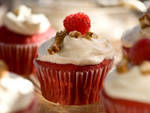
Red Velvet Cupcakes with Cream Cheese Frosting


Ingredients
2 1/2 cups all-purpose flour
1 1/2 cups sugar
1 teaspoon baking soda
1 teaspoon salt
1 teaspoon cocoa powder
1 1/2 cups vegetable oil
1 cup buttermilk, room temperature
2 large eggs, room temperature
2 tablespoons red food coloring
1 teaspoon white distilled vinegar
1 teaspoon vanilla extract
For the Cream Cheese Frosting:
1 pound cream cheese, softened
2 sticks butter, softened
1 teaspoon vanilla extract
4 cups sifted confectioners' sugar
Chopped pecans and fresh raspberries or strawberries, for garnish
Directions

Preheat the oven to 350 degrees F. Line 2 (12-cup) muffin pans with cupcake
papers.


In a medium mixing bowl, sift together the flour, sugar, baking soda, salt, and
cocoa powder. In a large bowl gently beat together the oil, buttermilk, eggs,
food coloring, vinegar, and vanilla with a handheld electric mixer. Add the
sifted dry ingredients to the wet and mix until smooth and thoroughly combined.


Divide the batter evenly among the cupcake tins about 2/3 filled. Bake in oven
for about 20 to 22 minutes, turning the pans once, half way through. Test the
cupcakes with a toothpick for doneness. Remove from oven and cool completely
before frosting.


For the Cream Cheese Frosting:

In a large mixing bowl, beat the cream cheese, butter and vanilla together until
smooth. Add the sugar and on low speed, beat until incorporated. Increase the
speed to high and mix until very light and fluffy.


Garnish with chopped pecans and a fresh raspberry or strawberry.

Cook's Note: Frost the cupcakes with a butter knife or pipe it on with a big
star tip.

Healthy Hotdogs

Recipe by Kim McCosker & Rachael Bermingham from 4 Ingredients


4 wraps
4 organic Sausages
1½ cups grated cheddar cheese
1 cup shredded carrot

Grill or BBQ sausages.
Lay wraps out and sprinkle equal portions of cheese onto each. Add chosen vegetable and rollup.

Sweet Chicken with Cornflakes

Recipe by Kim McCosker & Rachael Bermingham from 4 Ingredients

750 g organic chicken breast fillets
¾ cup organic Plain Yoghurt
2 cups Cornflakes ground
1 cup Parmesan Cheese
 

Preheat oven to 180C.
Combine cornflakes and cheese together in one bowl and place yoghurt in another bowl.
Coat chicken with yoghurt and then cornflake and cheese mixture.
Bake in oven for 20-30 minutes, depending on size of chicken breasts.
 

Swiss Schnitzel


2 chicken breasts
3 Slices multigrain bread grated into crumbs
2 tablespoons Olive Oil
4 Slices Jarlsberg Cheese
Cut chicken in half horizontally, using a rolling pin pound into slices until thin.
Coat with breadcrumbs, pressing into flesh to coat both sides.
Heat oil in a large non-stick frying pan.
Over moderate heat, cook schnitzels 2 at a time for 2 minutes, until golden on the bottom, turn and top with cheese.
Cook for a further 1-2 minutes or until chicken is tender and the cheese melts.

Recipe by Kim McCosker & Rachael Bermingham from 4 Ingredients

Burger Patties with Roasted Garlic Sauce


By: Chiqui Lloren


You can ditch the bread and have the patties as your ulam with rice.


Serves 4 Prep Time 50 minutes Cooking Time 5 minutes

250g ground pork
250g ground beef
1 small onion, chopped
2 teaspoons rock salt
1/4 teaspoon freshly ground pepper

Sauce
6 large heads of garlic
1/2 cup extra virgin olive oil
2 slices of white bread (remove crust)
2 tablespoons of lemon juice
salt and pepper

1 Place garlic bulbs in foil. Drizzle with some olive oil and sprinkle with salt.

2 Wrap in the foil and bake in preheated oven (400°F) for 45 minutes or until soft.

3 Cool garlic, chop off top, and squeeze out garlic cloves.

4 Soak bread in water for 1 minute, squeeze dry, and place in food processor or blender.

5 Add garlic and process into a smooth paste. Add lemon juice, and gradually add rest of olive oil in a smooth stream to make a paste. Add salt and pepper to taste.

6 Preheat grill or pan to medium high.

7 Mix ground meat, onions, salt, and pepper. Shape into 4 patties

8 Place on pan or grill until cooked. Serve with garlic sauce.


Photography by Ocs Alvarez & Lucky Besa | Styling by Melanie Jimenez

Special BLT Sandwich

By: Sharlene Tan & Elaine Lim

 A filling and flavorful sandwich you'll want to have not just on 'special' days


Serves 2 Prep Time 10 minutes Cooking Time 10 minutes


4 slices of bacon
2 cheese slices
2 large whole-wheat bread slices
1 tablespoon mayonnaise
4 slices of tomato
2 lettuce leaves
1 teaspoon butter
2 eggs


1 Cook the bacon until crisp; drain on paper towels. Set aside.
2 Place cheese slices on one slice of bread and toast together until melted.
3 On the other slice of bread, spread mayonnaise. Top with bacon, sliced tomato, and lettuce.
4 In a nonstick skillet, fry the eggs in butter, keeping yolks runny.
5 Slide the eggs on top of the lettuce. Top with the other toast with melted cheese.
6 Place the sandwich on a plate, slice in half, and serve.


Photography by David Hanson │ Food Styling by Sharlene Tan and Elaine Lim │ Prop Styling by Cleone Baradas

Mother’s Day French Toast

By: Myra Santiago

Make this one for breakfast to impress someone special (your mom!). Just remember to be patient when slow-cooking the egg.

Serves 1 Prep Time 1 minute Total Cooking Time 6 minutes

2 tablespoons butter
2 thick bread slices, with holes cut in the center
1/2 cup fresh milk
2 eggs

1 Place a small juice glass in the center of a slice of bread and cut around it, creating a hole in the middle. Dip the bread slices in a bowl of milk, allowing it to moisten most of the slice without getting it soggy. Handle carefully to prevent the bread from breaking apart.

2 Heat to medium a Teflon-coated skillet and gently melt 1 tablespoon of butter. Place a slice of bread in the pan and fry until golden brown. Turn the slice over and crack an egg into the empty center. Bring the heat down to low and allow the egg to cook slowly until the whites have set.

3 Serve quickly with a side of crispy bacon strips or slices of ham and cheese.